|
|
|
The Monterey
International
Pop Music Festival
Monterey County Fairgrounds,
Monterey, California
June 16 - 18, 1967
Founded by
Lou Adler, John Phillips, Alan Pariser
Introduction
From a purely musical
perspective, the Monterey International
Pop Music Festival was a groundbreaking
event bringing together nearly three dozen
well-known and unknown acts representing
an eclectic mix of styles and sounds.
The concert was a three-day
event held June 16 to June 18, 1967 at
the Monterey County Fairgrounds in Monterey,
California. Crowd estimates for the festival
have ranged from 25,000-90,000 people,
who congregated in and around the festival
grounds.Festival goers could buy a full
weekend ticket, or tickets for separate
shows. The showground arena, where the
performances took place, had 5,850 stand
seats, but many others had floor and perimeter
standing tickets. Tickets were also sold
to allow people to enter the fairgrounds
without access to the performance arena.
The Feastival heralded
in the 1967 "Summer of Love"
and featured such well-known acts as the
Animals, the Association, the Byrds, Jefferson
Airplane and the Mamas and the Papas and
is remembered for the first major American
appearances by The Jimi Hendrix Experience
and The Who and the first large-scale
public performance of Janis Joplin, the
introduction of Otis Redding, the Indian
sitar master Ravi Shankar and South African
singer/trumpeter Hugh Masekala, to a large
predominantly white audience.
In this sense, the Festival
not only pioneered the basic idea of a large-scale,
multi-day rock festival, but it also provided
the creative template that such festivals
still follow to this day. |
| Performers
Set List
This is
a set list of the performers at the Monterey
Pop Festival.
Friday,
June 16. Evening
The
Association / Introduced by John Phillips
1-
Along Comes Mary - (source:
1967 Monterey Pop) |
|
|
| 2
- Enter The Young -
(source: Album)
|
video |
|
|
3 - Windy - (source:
1967 Ravinia Festival - Highland
Park IL ). |
|
|
The
Paupers / Introduced by David Crosby
1
- Magic People - (source:
music promo video) |
|
|
| 2
- Think I Care - (source:
45) |
video
|
|
|
3 - Tudor Impressions
|
video
|
mp3 |
4
- Simple Deed - (source:
Album) |
video
|
|
5
- Let Me Be |
video
|
mp3 |
6
- Dr. Feelgood/Bass Solo/Dr. Feelgood |
video
|
mp3 |
Lou
Rawls / Introduced by Peter Tork
1
- Love Is A Hurtin' Thing |
|
|
| 2
- Dead End Street |
|
|
3
- Tobacco Road |
video
|
|
4
- On A Clear Day You Can See Forever |
video
|
|
5
- Autumn Leaves |
video
|
|
Beverley
Kutner / Introduced by Paul Simon
1
- Sweet Joy |
video
|
mp3 |
| 2
- Sweet Honesty |
video
|
mp3 |
3
- Picking Up the Sunshine
|
video
|
mp3 |
Johnny
Rivers
1
- Help Me, Rhonda |
video
|
|
| 2
- Memphis, Tennessee - (source:
American Bandstand TV)
|
video
|
|
|
3 - Mountain of Love - (source:
1967
Hollywood Bowl) |
|
|
4
- Midnight Special |
|
|
5
- Do What You Gotta Do |
video
|
|
6
- Tunesmith |
video
|
|
7
- Baby I Need Your Loving - (source:
1967
Hollywood Bowl) |
|
|
8
- Poor Side of Town - (source:
1967
Hollywood Bowl) |
video
|
|
9
- Secret Agent Man - (source:
1967
Hollywood Bowl) |
|
|
Eric Burdon &
The Animals / Introduced by Chet Helms
|
|
|
2
- Gin House Blues |
video
|
|
3
- Hey Gyp
- (source: Unknown
Concert circa 1967) |
|
|
4
- Paint It, Black - (source:
1967 Monterey Pop Festival) |
|
|
Simon and Garfunkel
1
- Homeward Bound - (source:
) |
video
|
mp3 |
2
- At The Zoo - (source:
) |
video
|
mp3 |
3
- The 59th Street Bridge Song
- (source: )
|
video
|
mp3 |
4
- For Emily, Whenever I May Find
Her - (source:
) |
video
|
mp3 |
5
- The Sound of Silence - (source:
) |
video
|
mp3 |
6
- Benedictus - (source:
) |
video
|
mp3 |
7
- Punky's Dilemma - (source:
) |
video
|
mp3 |
Saturday,
June 17. Afternoon
Canned Heat /
Introduced by John Phillips
1
- Rollin' And Tumblin' - (source:
) |
video
|
mp3 |
2
- Dust My Broom - (source:
) |
video
|
mp3 |
3
- Bullfrog Blues - (source:
) |
video
|
mp3 |
Janis Joplin with
Big Brother and the Holding Company /
Introduced by Chet Helms
1
- Down on Me - (source:
) |
video
|
mp3 |
2
- Combination of the Two - (source:
) |
video
|
mp3 |
3
- Harry - (source:
) |
video
|
mp3 |
4
- Roadblock - (source:
) |
video
|
mp3 |
5
- Ball 'n' Chain - (source:
) |
video
|
mp3 |
Country Joe and
the Fish
1
- Not So Sweet Martha Lorraine
- (source: )
|
video
|
mp3 |
2
- I-Feel-Like-I'm-Fixin'-to-Die
Rag - (source:
) |
video
|
mp3 |
3
- The Bomb Song - (source:
) |
video
|
mp3 |
4
- Section 43 - (source:
) |
video
|
mp3 |
Al Kooper / Introduced
by Paul Butterfield
1
- I Can't Keep from Cryin' Sometimes
- (source: )
|
video
|
mp3 |
2
- Wake Me, Shake Me - (source:
) |
video
|
mp3 |
The Paul Butterfield
Blues Band
1
- Look Over Yonders Wall - (source:
) |
video
|
mp3 |
2
- Mystery Train - (source:
) |
video
|
mp3 |
3
- Born In Chicago - (source:
) |
video
|
mp3 |
4
- Double Trouble - (source:
) |
video
|
mp3 |
5
- Mary Ann - (source:
) |
video
|
mp3 |
6
- Droppin' Out - (source:
) |
video
|
mp3 |
7
- One More Heartache - (source:
) |
video
|
mp3 |
8
- Driftin' Blues - (source:
) |
video
|
mp3 |
Quicksilver Messenger
Service
1
- Dino's Song (All I Ever Wanted
to Do) - (source:
) |
video
|
mp3 |
2
- If You Live - (source:
) |
video
|
mp3 |
3
- Acapulco Gold and Silver - (source:
) |
video
|
mp3 |
4
- Too Long - (source:
) |
video
|
mp3 |
5
- Who Do You Love? - (source:
) |
video
|
mp3 |
Steve Miller Band
1
- Living in the USA - (source:
) |
video
|
mp3 |
2
- Mercury Blues - (source:
) |
video
|
mp3 |
Mike Bloomfield
with The Electric Flag / Introduced by
David Crosby
1
- Groovin' Is Easy - (source:
) |
video
|
mp3 |
2
- Over-Lovin' You - (source:
) |
video
|
mp3 |
3
- The Night Time Is the Right
Time - (source:
) |
video
|
mp3 |
4 - Wine - (source:
) |
video
|
mp3 |
Saturday,
June 17. Evening
Moby Grape / Introduced
by Tom Smothers.
1
- Indifference - (source:
) |
video
|
mp3 |
2
- Mr. Blues - (source:
) |
video
|
mp3 |
3
- Sitting By the Window - (source:
) |
video
|
mp3 |
4
- Omaha - (source:
) |
video
|
mp3 |
5
- Fall On You - (source:
) |
video
|
mp3 |
Hugh Masekela
1
- Here, There And Everywhere -
(source: )
|
video
|
mp3 |
2
- Society's Child - (source:
) |
video
|
mp3 |
3
- Bajabula Bonke (Healing Song)
- (source: )
|
video
|
mp3 |
The Byrds / Introduced
by Mike Bloomfield
1
- Renaissance Fair - (source:
) |
video
|
mp3 |
2
- Have You Seen Her Face - (source:
) |
video
|
mp3 |
3
- Hey Joe - (source:
) |
video
|
mp3 |
4
- He Was a Friend of Mine - (source:
) |
video
|
mp3 |
5
- Lady Friend - (source:
) |
video
|
mp3 |
6
- Chimes of Freedom - (source:
) |
video
|
mp3 |
7
- So You Want to Be a Rock 'n'
Roll Star - (source:
) |
video
|
mp3 |
Laura Nyro
1
- Wedding Bell Blues - (source:
) |
video
|
mp3 |
2
- Poverty Train - (source:
) |
video
|
mp3 |
3
- Eli's Coming - (source:
) |
video
|
mp3 |
Jefferson Airplane
/ Introduced by Jerry Garcia
1
- Somebody to Love - (source:
) |
video
|
mp3 |
2
- The Other Side of This Life
- (source: )
|
video
|
mp3 |
3
- White Rabbit - (source:
) |
video
|
mp3 |
4
- High Flying Bird - (source:
) |
video
|
mp3 |
5
- Today - (source:
) |
video
|
mp3 |
6
- She Has Funny Cars - (source:
) |
video
|
mp3 |
7
- Young Girl Sunday Blues - (source:
) |
video
|
mp3 |
8
- The Ballad of You and Me and
Pooneil - (source:
) |
video
|
mp3 |
Booker T. &
the M.G.s
1
- Booker Loo - (source:
) |
video
|
mp3 |
2
- Hip Hug-Her - (source:
) |
video
|
mp3 |
3
- Philly Dog - (source:
)
|
video
|
mp3 |
4
- Green Onions - (source:
) |
video
|
mp3 |
Otis Redding /
Introduced by Tommy Smothers
1
- Shake - (source:
) |
video
|
mp3 |
2
- Respect - (source:
) |
video
|
mp3 |
3
- I've Been Loving You Too Long
- (source: )
|
video
|
mp3 |
4
- Satisfaction - (source:
) |
video
|
mp3 |
5
- Try a Little Tenderness - (source:
) |
video
|
mp3 |
Sunday,
June 18. Afternoon
Ravi Shankar
1
- Rãga Bhimpalasi - (source:
) |
video
|
mp3 |
2
- Rãga Todi-Rupak Tal (7
Beats) - (source:
) |
video
|
mp3 |
3
- Tabla Solo In Ektal (12 Beats)
- (source: )
|
video
|
mp3 |
4
- Rãga Shuddha Sarang-Tintal
(16 Beats) - (source:
) |
video
|
mp3 |
5
- Dhun In dadra and fast teental
(6 and 16 beats) - (source:
) |
video
|
mp3 |
Sunday,
June 18. Evening
Al Kooper and
Blues Project / Introduction by Tom Smothers.
1
- Flute Thing - (source:
) |
video
|
mp3 |
2
- Wake Me, Shake Me - (source:
) |
video
|
mp3 |
Janis Joplin with
Big Brother and the Holding Company /
Introduced by Tommy Smothers
1
- Combination of the Two - (source:
) |
video
|
mp3 |
2
- Ball and Chain - (source:
) |
video
|
mp3 |
Note: Big Brother and
the Holding Company second set. This set
was filmed for Monterey Pop. The first
set was not filmed, but the band wanted
to get on the film after their first set
went down to huge acclaim.
The Group With
No Name
Set list unknown.
Buffalo Springfield
/ Introduced by Peter Tork
1
- For What It's Worth - (source:
) |
video
|
mp3 |
2
- Nowadays Clancy Can't Even Sing
- (source: )
|
video
|
mp3 |
3
- Rock and Roll Woman - (source:
) |
video
|
mp3 |
4
- Bluebird - (source:
) |
video
|
mp3 |
5
- A Child's Claim to Fame - (source:
) |
video
|
mp3 |
6
- Pretty Girl Why - (source:
) |
video
|
mp3 |
The Who / Introduced
by Eric Burdon
1
- Substitute - (source:
) |
video
|
mp3 |
2
- Summertime Blues - (source:
) |
video
|
mp3 |
3
- Pictures of Lily - (source:
) |
video
|
mp3 |
4
- A Quick One, While He's Away
- (source: ) |
video
|
mp3 |
5
- Happy Jack - (source:
) |
video
|
mp3 |
6
- My Generation - (source:
) |
video
|
mp3 |
Grateful Dead
1
- Viola Lee Blues - (source:
) |
video
|
mp3 |
2
- Cold Rain and Snow - (source:
) |
video
|
mp3 |
3
- Alligator/Caution (Do Not Stop
On Tracks) - (source:
) |
video
|
mp3 |
The Jimi Hendrix
Experience / Introduced by Brian Jones.
1
- Killing Floor - (source:
) |
video
|
mp3 |
2
- Foxy Lady - (source:
) |
video
|
mp3 |
3 - Like a Rolling Stone - (source:
) |
video
|
mp3 |
4
- Rock Me Baby - (source:
) |
video
|
mp3 |
5
- Hey Joe - (source:
) |
video
|
mp3 |
6
- Can You See Me - (source:
) |
video
|
mp3 |
7
- The Wind Cries Mary - (source:
) |
video
|
mp3 |
8
- Purple Haze - (source:
) |
video
|
mp3 |
9
- Wild Thing - (source:
) |
video
|
mp3 |
The Mamas &
the Papas / Introduced by Paul Simon.
1
- Straight Shooter - (source:
) |
video
|
mp3 |
2
- Spanish Harlem - (source:
) |
video
|
mp3 |
3
- Somebody Groovy - (source:
) |
video
|
mp3 |
4
- Got a Feelin' - (source:
) |
video
|
mp3 |
5
- California Dreamin' - (source:
) |
video
|
mp3 |
6
- I Call Your Name - (source:
) |
video
|
mp3 |
7
- Monday, Monday - (source:
) |
video
|
mp3 |
Scott McKenzie / Backed by The Mamas &
the Papas
1
- San Francisco - (source:
) |
video
|
mp3 |
The Mamas & the Papas & Scott McKenzie
1
- Dancing In The Streets (Finale)
- (source: )
|
video
|
mp3 |
|
|
History
The Monterey International
Pop Music Festival was a three-day
concert event held June 16 to June 18, 1967
at the Monterey County Fairgrounds in Monterey,
California.
Crowd estimates for the
festival have ranged from 25,000-90,000
people, who congregated in and around the
festival grounds. The fairgrounds’
enclosed performance arena, where the music
took place, had an approved festival capacity
of 7,000, but it was estimated that 8,500
jammed into it for Saturday night’s
show.
Festival-goers who wanted
to see the musical performances were required
to have either an 'all-festival' ticket
or a separate ticket for each of the five
scheduled concert events they wanted to
attend in the arena: Friday night, Saturday
afternoon and night, and Sunday afternoon
and night. Ticket prices varied by seating
area, and ranged from $3 to $6.50.
The festival is remembered
for the first major American appearances
by The Jimi Hendrix Experience,
The Who and Ravi Shankar, the first
large-scale public performance of Janis
Joplin and the introduction of
Otis Redding to a large,
predominantly white audience.
The Monterey Pop Festival embodied
the theme of California as a focal point for
the counterculture and is generally regarded
as one of the beginnings of the "Summer
of Love" in 1967; the first
rock festival had been held just one week
earlier at Mount Tamalpais
in Marin County, the KFRC
Fantasy Fair and Magic Mountain Music
Festival. Because Monterey was widely
promoted and heavily attended, featured historic
performances, and was the subject of a popular
theatrical documentary film, it became an
inspiration and a template for future music
festivals, including the Woodstock Festival
two years later. |
|
The
Festival
The festival was planned
in seven weeks by promoter Lou Adler,
John Phillips of The Mamas & the Papas,
producer Alan Pariser and
publicist Derek Taylor.
The Monterey location had been known as
the site for the long-running Monterey
Jazz Festival and Monterey
Folk Festival; the promoters saw
the Monterey Pop festival as a way to validate
rock music as an art form in the way in
which jazz and folk were regarded. The organizers
succeeded beyond all expectations.
The artists performed for
free with all revenue donated to charity,
except for Ravi Shankar,
who was paid $3,000 for his afternoon-long
performance on the sitar. Country
Joe and the Fish were paid $5,000
not by the festival itself, but from revenue
generated from the D.A. Pennebaker
documentary.
Lou Adler later reflected:
…Our idea for Monterey
was to provide the best of everything --
sound equipment, sleeping and eating accommodations,
transportation -- services that had never
been provided for the artist before Monterey.
We set up an on-site first
aid clinic, because we knew there would
be a need for medical supervision and that
we would encounter drug-related problems.
We didn't want people who got themselves
into trouble and needed medical attention
to go untreated. Nor did we want their problems
to ruin or in any way disturb other people
or disrupt the music.
Our security worked with
the Monterey police. The local law enforcement
authorities never expected to like the people
they came in contact with as much as they
did. They never expected the spirit of 'Music,
Love and Flowers' to take over to the point
where they'd allow themselves to be festooned
with flowers.
Monterey's bill boasted a lineup
that put established stars like The
Mamas and the Papas, Simon & Garfunkel
and The Byrds alongside groundbreaking
new acts from the UK and the USA. |
| Performances
Jefferson Airplane
With two huge singles behind
them, the Airplane was one of the major
attractions of the festival.
The
Who
Although already a big act
in the UK, and now gaining some attention
in the US after playing some New York dates
two months earlier, The Who
were propelled into the American mainstream
at Monterey. The band used rented Vox
amps for their set, which were
not as powerful as their regular Sound City
amps which they had left in England to save
shipping costs. At the end of their frenetic
performance of "My Generation",
the audience was stunned as guitarist Pete
Townshend smashed his guitar, smoke
bombs exploded behind the amps and frightened
concert staff rushed onstage to retrieve
expensive microphones. At the end of the
mayhem, drummer Keith Moon kicked
over his drum kit as the band exited the
stage. The Who, after winning a coin toss,
performed before Jimi Hendrix,
as Townshend and Hendrix each refused to
go on after the other, both having planned
instrument-demolishing conclusions to their
respective sets.
The
Jimi Hendrix Experience
Hendrix
ended his Monterey performance with an unpredictable
version of "Wild Thing",
which he capped by kneeling over his guitar,
pouring lighter fluid over it, setting it
on fire, and then smashing it in to the
stage seven times before throwing its remains
into the audience. This produced wild, unpredictable
sounds, and these actions contributed to
his rising popularity in the United States.
Robert Christgau later wrote in The
Village Voice of Hendrix's performance:
“ Music was a given for a Hendrix
stuck with topping the Who's guitar-smashing
tour de force. It's great sport to watch
this outrageous scene-stealer wiggle his
tongue, pick with his teeth, and set his
axe on fire, but the showboating does distract
from the history made that night—the
dawning of an instrumental technique so
effortlessly fecund and febrile that rock
has yet to equal it, though hundreds of
metal bands have gotten rich trying. Admittedly,
nowhere else will you witness a Hendrix
still uncertain of his divinity.”
Janis
Joplin
Monterey Pop was also one
of the earliest major public performances
for Janis Joplin, who appeared
as a member of Big Brother and The
Holding Company. Joplin gave a
provocative rendition of the song "Ball
'n' Chain". Columbia Records
signed Big Brother and The Holding Company
on the basis of their performance at Monterey.
Otis
Redding
Redding, backed
by Booker T. & The MG's,
was included on the bill through the efforts
of promoter Jerry Wexler,
who saw the festival as an opportunity to
advance Redding's career.
Until that point, Redding had performed mainly
for black audiences, besides a few successful
shows at the Whisky a Go Go. Redding's show,
received well by the audience ("there
is certainly more audible crowd participation
in Redding's set than in any of the others
filmed by Pennebaker that
weekend") included "Respect"
and a version of "Satisfaction".
The festival would be one of his last major
performances. He died six months later in
a plane crash at the age of 26.
Ravi
Shankar
Ravi Shankar
was another artist who was introduced to
America at the Monterey festival. The
Raga Dhun (Dadra and Fast Teental)
(which was later miscredited as "Raga
Bhimpalasi"), an excerpt from Shankar's
four-hour performance at the 1967 Monterey
Pop Festival, concluded the Monterey Pop
film, introducing the artist to a new generation
of music fans.
The
Mamas & the Papas
The Mamas &
the Papas performed the closing
act of the festival, as member John
Phillips helped organize the festival.
They also introduced several of the acts,
including Scott McKenzie.
They played some of their biggest hits,
including "Monday, Monday"
and "California Dreamin".
Cancellations
and no-shows
Several acts were also notable
for their non-appearance.
The Beach Boys,
who had been involved in the conception
of the event and were at one point scheduled
to headline and close the show, failed to
perform. This resulted from a number of
issues plaguing the group. Carl
Wilson was in a feud with officials
for his refusal to be drafted into military
service during the Vietnam War. The group's
new, radical album Smile
had recently been aborted, with band leader
Brian Wilson in a depressed
state and unwilling to perform (he hadn't
performed live with the group since late
1964, although he would do so in Honolulu,
Hawaii in August 1967). Since Smile had
not been released, the group felt their
older material would not go over well. The
cancellation permanently damaged their reputation
and popularity in the US, which would contribute
to their replacement album Smiley Smile
charting lower than any other of their previous
album releases.
The Beatles
were rumored to appear because of the involvement
of their press officer Derek Taylor,
but they declined, since their music had
become too complex to be performed live.
Instead, at the instigation of Paul
McCartney, the festival booked
The Who and the Jimi
Hendrix Experience.
The Kinks were
invited but could not get a work visa to
enter the US because of a dispute with the
American Federation of Musicians.
Donovan was
refused a visa to enter the United States
because of a 1966 drug bust.
Captain
Beefheart & the Magic Band
was also invited to appear but, according
to the liner notes for the CD reissue of
their album Safe As Milk, the band turned
the offer down at the insistence of guitarist
Ry Cooder, who felt the
group was not ready.
Dionne Warwick
and The Impressions were advertised on some
of the early posters for the event, but
Warwick dropped out because of a conflict
in booking that weekend. She was booked
at the Fairmont Hotel; the hotel was reluctant
to release her and it was thought that cancelling
that appearance would negatively affect
her career.
Even though the logo for
the band Kaleidoscope is
seen in the film as a pink sign just below
the stage, the band did not perform at the
Monterey Festival.
Although The Rolling
Stones did not play, guitarist
and founder Brian Jones
attended and appeared on stage to introduce
Hendrix. The group was
on the short list of invitees, but was unable
to get work visas because of the drug arrests
of Mick Jagger and Keith
Richards.
It was long rumored that
Love had declined an invitation
to Woodstock, but Mojo
Magazine later confirmed that it was the
Monterey Festival they had rejected.
The promoters also invited
several Motown artists to perform and even
were going to give the label's artists their
own slot. However, Berry Gordy
refused to let any of his acts appear, even
though Smokey Robinson
was on the board of directors.
The Doors
did not appear because the coordinators
forgot to invite them. Drummer John
Densmore, in his book Riders on
the Storm, expressed his belief that the
band was not invited because its music didn't
express the "peace and love" ideals
of the time. The real matter instead was
that, back in 1965, they took their demo
to the Dunhill Records, where Lou
Adler, the head man, rejected the
whole thing. "Nothing here I can use"
he said, "That's ok, man. We don't
want to be used anyway" Morrison
replied. Because Lou Adler
was also one of the promoters of the Monterey
Pop Festival, The Doors
were never invited to play there.
The Monkees
were the biggest-selling musical act in
the United States in 1967 and were seriously
considered to play, but after weeks of deliberation,
John Phillips and Lou Adler
decided not to invite them. However, group
members Micky Dolenz (in
full American Indian buckskins and headdress)
and Peter Tork attended
the festival and mingled with musicians
backstage. Tork was asked to introduce Buffalo
Springfield, his favorite group,
for their set. Tork also introduced Lou
Rawls and was involved in a bizarre incident
where he walked out onstage in the middle
of the Grateful Dead's
set when he went out to try to stop fans
from climbing on stage and dancing as well
as to inform the crowd that The
Beatles were not at the festival
in disguise.
According to Eric Clapton,
Cream did not perform because the
band's manager wanted to make a bigger splash
for their American debut. However, it has
since been revealed that the band were not
considered by the festival organizers. |
|
Influence
Music writer Rusty DeSoto
argues that pop music history tends to downplay
the importance of Monterey in favor of the
"bigger, higher-profile, more decadent"
Woodstock Festival, held two years later.
But, as he notes:
…Monterey Pop was
a seminal event... featuring debut performances
of bands that would shape the history of
rock and affect popular culture from that
day forward. The County Fairgrounds in Monterey,
California … had been home to folk,
jazz and blues festivals for many years.
But the weekend of June 16–18, 1967
was the first time it was used to showcase
rock music.
The festival launched the
careers of many who played there, making
some of them into stars virtually overnight,
including Janis Joplin, Laura Nyro,
Canned Heat, Otis Redding, Steve Miller
and Indian sitar maestro Ravi Shankar.
Monterey was also the first
high-profile event to mix acts from major
regional music centers in the U.S.A. —
San Francisco, Los Angeles, Chicago, Memphis
and New York City — and it was the
first time many of these bands had met each
other in person. It was a particularly important
meeting place for bands from the Bay Area
and L.A., who had tended to regard each
other with a degree of suspicion —
Frank Zappa for one made
no secret of his low regard for some of
the San Francisco bands — and until
that point the two scenes had been developing
separately along fairly distinct lines.
Paul Kantner of Jefferson
Airplane said “The idea that
San Francisco was heralding was a bit of
freedom from oppression.”
Monterey also marked a significant
changing of the guard in British music.
The Who and Eric
Burdon and The Animals represented
the UK, with the Beatles
and the Rolling Stones
conspicuously absent. The Stones' Brian
Jones wafted through the crowd,
resplendent in full psychedelic regalia,
and appeared on stage briefly to introduce
Jimi Hendrix. It would
be two more years before The Stones hit
the road, by which time Jones was dead,
and the Beatles never toured again. Meanwhile,
The Who leapt into the
breach and became the top British touring
act of the period.
Also notable was the festival's
innovative sound system, designed and built
by audio engineer Abe Jacob, who started
his career doing live sound for San Francisco
bands and went on to become a leading sound
designer for the American theater. Jacob's
groundbreaking Monterey sound system was
the progenitor of all the large-scale PAs
that followed. It was a key factor in the
festival's success and it was greatly appreciated
by the artists—in the Monterey film,
David Crosby can clearly
be seen saying "Great sound system!"
to band-mate Chris Hillman
at the start of the Byrds'
soundcheck. Lighting by Chip Monck
attracted the attention of the Woodstock
Festival promoters.
Electronic music pioneers
Paul Beaver and Bernie Krause set up a booth
at Monterey to demonstrate the new electronic
music synthesizer developed by Robert
Moog. Beaver and Krause had bought
one of Moog's first synthesizers in 1966
and had spent a fruitless year trying to
get someone in Hollywood interested in using
it. Through their demonstration booth at
Monterey, they gained the interest of acts
including The Doors, The Byrds,
The Rolling Stones, Simon & Garfunkel
and others. This quickly built into a steady
stream of business, and the eccentric Beaver
was soon one of the busiest session men
in L.A. He and Krause earned a contract
with Warner Brothers.
Eric Burdon and the
Animals later that same year, in
their hit "Monterey", quoted a line
from the Byrds' song "Renaissance Fair"
("I think that maybe I'm dreamin'")
and mentioned performers the Byrds, Jefferson
Airplane, Ravi Shankar, Jimi Hendrix, the
Who, Hugh Masekela, Grateful Dead and the
Rolling Stones' Brian Jones ("His Majesty
Prince Jones smiled as he moved among the
crowd").
The instruments used in the song imitate the
styles of these performers. |
|
Recording
and filming the festival
The festival was the subject
of an acclaimed documentary movie entitled
Monterey Pop, by noted documentary filmmaker
D.A. Pennebaker. Pennebaker's team used
recently developed portable 16mm crystal-sync
motion picture cameras that stayed synchronized
with double-system sound-recording systems.
The film stock was Eastman
Kodak's recently released "high-speed"
16mm Ektachrome 100 ASA color reversal motion
picture stock, without which the nighttime
shows would have been virtually impossible
to shoot in color. Sound was captured by
Wally Heider's mobile studio on state-of-the
art eight-track tape, with one track used
for the crystal-sync tone, to synchronize
it with the film cameras.
The Grateful Dead believed
that the film was too commercial and refused
permission to be shown. The screening of
the film in theaters nationwide helped raise
the festival to mythic status, rapidly swelled
the ranks of would-be festival-goers looking
for the next festival, and inspired new
entrepreneurs to stage more such festivals
around the country.
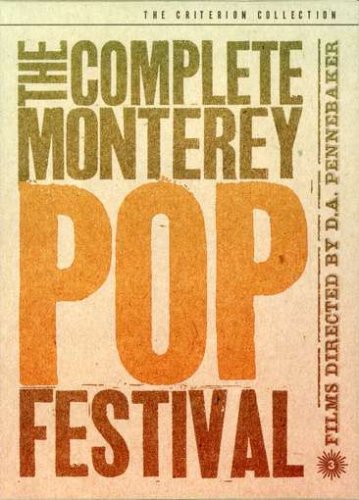
An expanded version of the
documentary has been released on DVD by
the Criterion Collection.
The audio recordings of
the festival eventually became the basis
for many albums, most notably the 1970 release
Historic Performances Recorded at the Monterey
International Pop Festival featuring partial
sets by Otis Redding and Jimi Hendrix.
Other releases recorded
at the festival included the Grateful Dead,
Jefferson Airplane and Ravi Shankar. In
1992, a four-CD box set was released featuring
performances by most of the artists; various
other compilations have been released over
the years.
According to a radio promotional
feature that accompanied the box set release,
on modified stages, including flatbed {Kaleidscope
(LA)} trucks, set up in the surrounding environs,
there had been several spontaneous jam sessions
for the overflow crowds and campers.
Among them was one at the Monterey Peninsula
Community College sports stadium (right across
the Hwy. 1 interchange), where Jimi Hendrix,
flanked by Jorma Kaukonen and John Cippolina,
played for the adoring throng. It was also
reported locally that Eric Burdon had checked
out the provisions and healthcare facilities.
|
| Films |
The
Criterion Collection
by D.A. Pennebaker
The Complete Monterey Pop
Festival
79 mins The
Complete Monterey Pop Festival
The Outtake Performances
With commentary by Don Pennebaker
and Lou Adler. 123 minutes
The Criterion Collection is the
most comprehensive document of
The Monterey International Pop
Festival ever produced, featuring
all three films of the festival
- Monterey Pop, Jimi Plays Monterey
and Shake! Otis At Monterey -
along with nearly every complete
performance filmed by D.A. Pennebaker
and his crew, including Simon
& Garfunkel, The Mamas and
the Papas, The Who, The Byrds,
Hugh Masekela, and Ravi Shankar. |
|
|
Jimi
Plays Monterey
SHAKE! Otis at Monterey
While half of this was
previously available as one side
of an LP that also featured a
side of live Otis Redding from
the same event, Jimi Plays Monterey
has his whole performance.
Jimi Hendrix and
Otis Redding arrived in California
virtually unknown. Returning stateside
from London, where he had moved
to launch his musical career, Hendrix
exploded at Monterey, flooring an
unsuspecting audience with his maniacal
six-string pyrotechnics. Redding,
venerable star of Memphis' Stax
record label, seduced the "love
crowd" in one of his best--
and last-- performances. Jimi Plays
Monterey and Shake! Otis at Monterey
feature the entire Monterey sets
of these legendary musicians, performances
that have entered rock and roll
mythology. 68 Minutes |
|
|
Ravi Shankar
at Monterey Pop
Show excerpt .mp4 (4m.03s)
Ravi Shankar
at
Monterey Pop
Show excerpts with crowd scenes
(18m.42s) |
|
|
Related
Films |
Straight
Shooter
The Mamas and the Papas
Documentary - The life, loves and
music of John Phillips, Cass Elliot,
Michelle Phillips and Denny Doherty
are revealed in an intimate musical
experience that could have only
happened in the sixties. Features
20 performances of hits. (1989)
.mp4 (55m.00s) |
|
|
| Radio |
The
Monterey Pop Festival
40 Years Later
NPR Radio Program mp3 - 7m.20s |
|
|
The
Monterey Pop Festival
40 Years Later
Michelle Phillips of The Mamas &
The Papas and producer Lou Adler
look back on the landmark 1967 Monterey
Pop Festival / The Leonard Lopate
Show WNYC 5 Jun 2007.mp3 - 23m32s |
|
WNYC
The Leonard
Lopate Show |
|
|
|
The
Monterey Pop Festival
45th Anniversary
NPR Radio Program mp3 - 1h.40m.20s |
|
|
Books
A
Perfect Haze:
The Illustrated History of the Monterey
International Pop Festival. Published
2012 |
|
|
|
|
|